Final Piece

For our final piece, we were inspired by Jenny Holzer’s use of repetitive text, we repeated the sentences that we found on gravestones, we decided to use ones found from the internet instead of from the local area as this is a sensitive topic and didn’t want someone in the class to perhaps recognise one of the graves and become upset.

This slideshow requires JavaScript.

We kept the text pieces black and white, this meant that our bright, Barbara Kruger style video would be able to be seen and also shows how China symbolises white as the colour of death and in Western countries it is black.

We displayed this video that Georgia had made onto the wall with the text on it.

The video contains real news headlines about death, flashing up in a quick, aggressive manor. This is supposed to force the viewer to see the headlines about death that normally they would just skip as it has become so normalised in the media.

At the side of our display we also had another display of black and white images of very old gravestones from Georgia’s local area of Fife. This was to further solidify the fact that real people have died.

This slideshow requires JavaScript.

Overall, we were very happy with the result of this project and the message that it gave out.

Reactions

Our public installation of the shocking news articles had gathered the attention that we wanted.

We were very happy to find that someone from our year and her friend posted their reaction to our work on Snapchat, further spreading and illustrating our message.

Photo credit: Azra Khan 50492044_772969796370257_2047974620165832704_n

Development

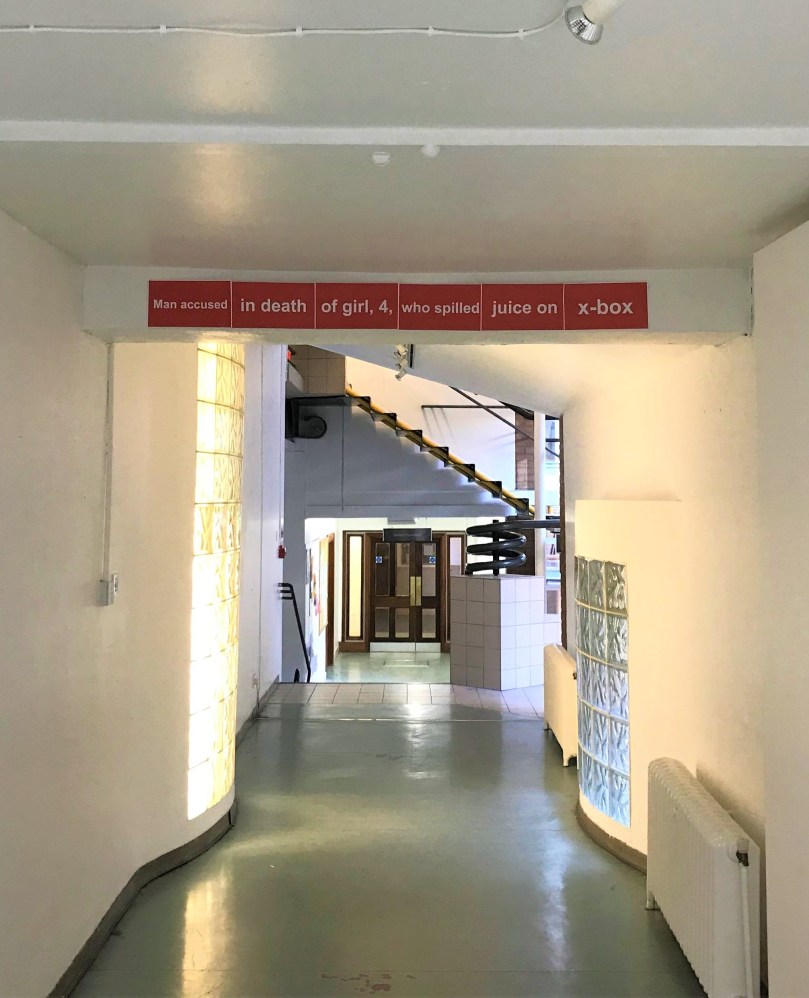
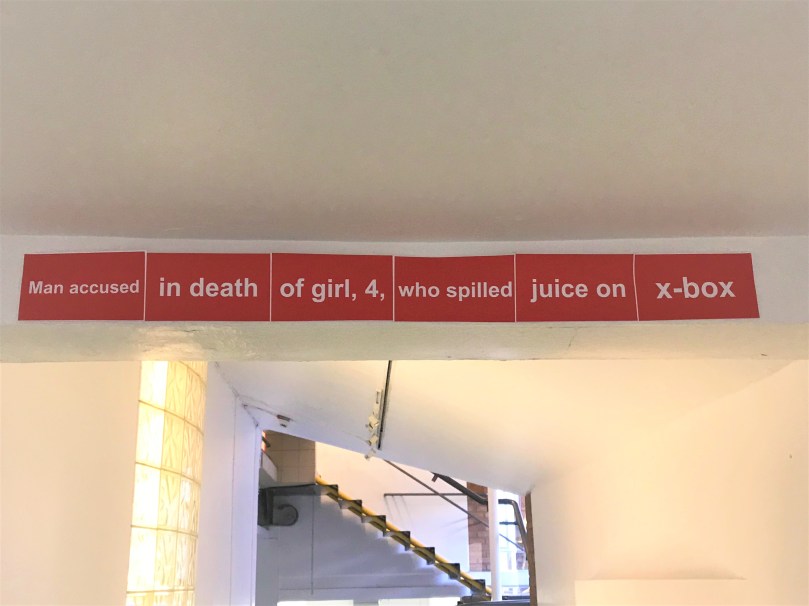
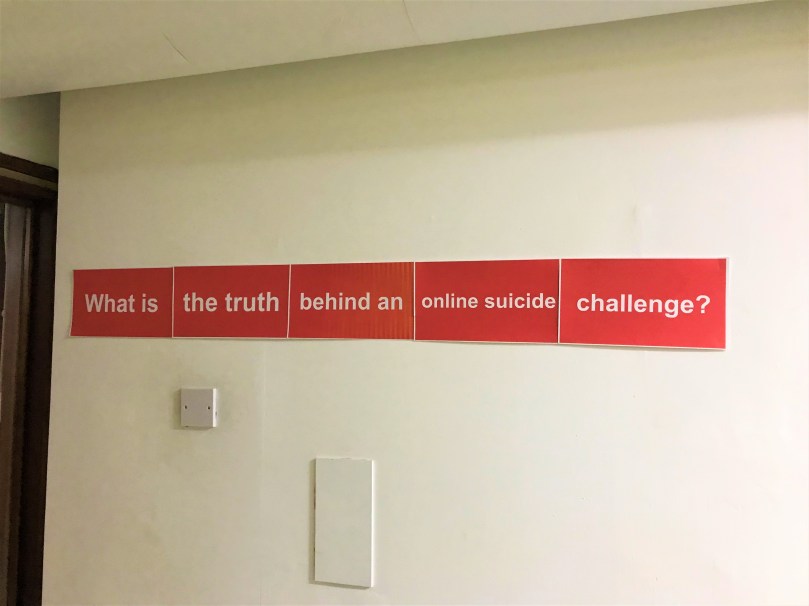
In the style of Barbara Kruger with the iconic and eyecatching white text on red background. We used the headlines from news articles of shocking deaths. We put these up around the school so that people are forced to read the headlines that most of the time they would ignore. Both Kruger and Holzer utilise public spaces for their art to cause public reaction, we wanted to do the same.

img_7327img_7323

img_7331While putting up these, we noticed that even the signs around the school use the same style of white text on red background. This shows the effectiveness of this style in attracting atention.

 

Cultural differences

In Japan, they believe in life after death and see dead bodies as still alive and so treat them as such, ensuring the bodies safe return home, ensuring all body parts are intact etc. Many Japanese and Eastern Asian youth are brought up to respect death and to not make fun of it like many western youth do, being taught about death from an early age. There is even a three-day holiday in Japan where the dead are remembered, fires are lit, graves are cleaned and the spirits are believed to return to the family. Even the colour symbolism is different as in China, white is the colour of mourning and not black.

This shows a contrast in the level of respect that cultures in Eastern Asia have compared to the western world.

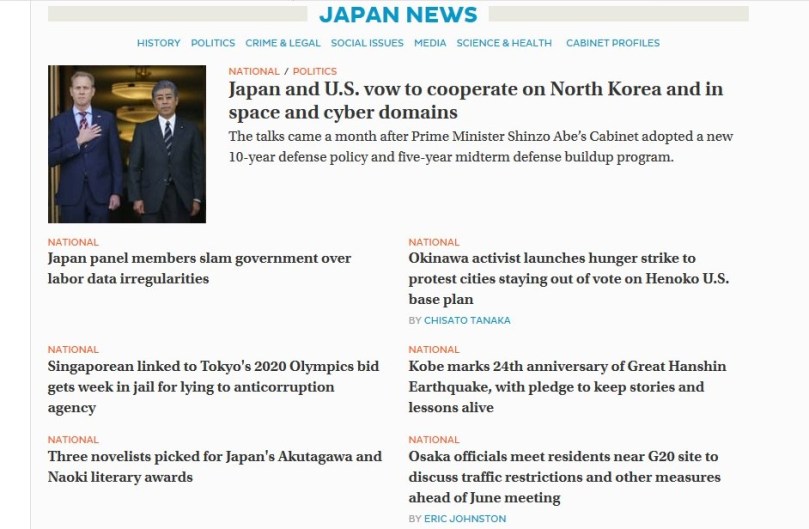
Their news sites also look different. There is little talk about death on the front pages of their news sites for example the Japan Times, there is no mention. There is also only one mention of death in their crime and legal section.

japan times

The 1975

The 1975 are a band who are very modern and in touch with social issues addressing hot topics like the refugee crisis, racism etc. They also have addressed this feeling amongst the youths of ‘wanting to die’/joking about death. Their song ‘I always wanna die (sometimes)’ sums up the general feeling of the youth who rather don’t want to die but escape from their current situation and take a break from life.

They also inspire this project due to the subject matter of their songs and also their aesthetic. During one of the concerts that I recently attended, they used many text displays in the same fashion as Jenny Holzer and Barbara Kruger.

At the end of their show they flashed up “ROCK AND ROLL IS DEAD GOD BLESS”

This statment was very impactful and left me wondering what it meant, much like what Kruger and Holzer’s statements do.

They also explicitly referenced Kruger’s style by incorporating her text style into their show while also referencing the brand Supreme which as mentioned earlier stole their logo design from Kruger.

the 1975 rifles 2

(photo credit – Sophie Watts on Youtube)

Humour and Death

Death has even become humorous amongst groups of users on the internet. For example, celebrity death pool 2019, a website where people can vote on which celebrity will die next. Imagine you were a celebrity and found yourself on this website, how would it make you feel? After all we are all humans with emotions, which celebrities are too.

celeb death pool

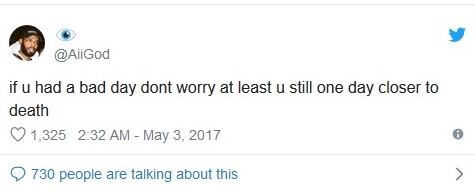
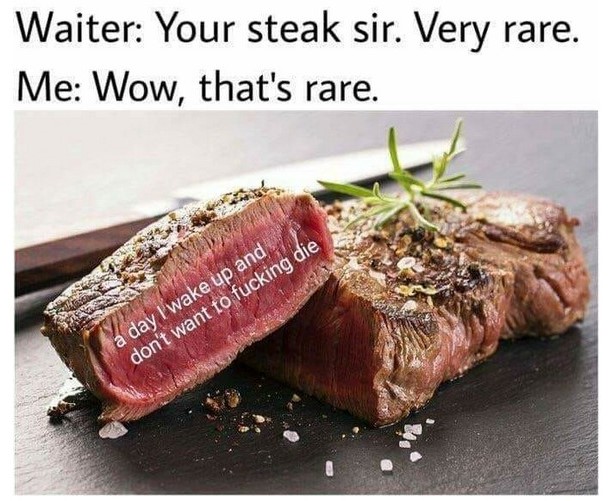
Joking about death and suicide is now widespread amongst the youth. With the rise of internet memes, joking about suicide has become more accessible and trendier than ever. Even though many of these jokes are made by people who aren’t depressed but rather frustrated at the current climate in terms of politics and other saddening events which make life difficult to deal with, this still adds to the normalisation of death. In trying to deal with horrible situation with humour, it detracts the seriousness of the topic.

https://mic.com/articles/181752/why-does-everyone-on-the-internet-want-to-die-how-death-memes-took-over-the-web#.JRSQgijSS

meme 1meme 2


Death in society and the media – is it normalised?

Due to the availability of information streamed over a digital platform 24/7, the reports of death all over the world are prevalent. This overload of information from social media, newspapers, websites etc. creates a culture of apathy. Death seems to become normalised and it shouldn’t. Think about the devastating personal, emotional impact that a close death has to you. This reaction is not shared by the wider public who generally do not care. Deaths that are reported in the news rarely get a second glance as it happens everyday.

BBC news wesbite for England and Scotland 14/01/19

bbc news_libbc news 2_li

Collaboration Project

I am working with Georgia Legg, before the project we didn’t know eachother. We started off by trying to get to know eachother a bit better, talking about what type of art that we like. She said that she was inspired by Jenny Holzer and Barbara Kruger with their text based work. I had never heard of them before so I researched into them. I suggested that we could have our theme about how death seems to have become normalised and we both agreed it was an intersting topic.


Jenny Holzer

Based in New York, Holzer is very focused on the idea of text and how that can be perceived by the public. She uses large installations like billboards, LED displays, benches etc. to get her political and personal messages across in urban environments, ones in which aren’t expected to be seen outside in the public, making strangers on the street question themselves as they interpret her messages. She likes to make her art and wordplay accessible and understandable to everyone, not just people of the art world. They are punchy and eye-catching.

My collaboration partner Georgia saw that her train had a very Jenny Holzer like screen displaying text, this shows that Holzer is influenced by the objects around her.

Barbara Kruger

Kruger is most famous for her black and white found images silk screen printed on with short, bold statements in white text and red background. This is very eye-catching and usually addresses issues in society like capitalism and women’s rights. Her messages are often confrontational and make the viewer contemplate the issue.

Ironically, skate apparel company ‘Supreme’ has stolen Krugers famous design for their own brand. Krugers point of capitalism being such a wide spread issue has been proven.

supreme